
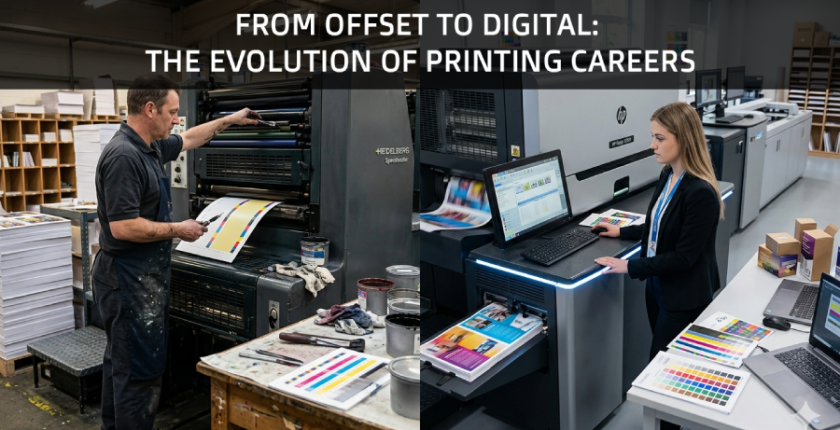
From Offset to Digital: The Evolution of Printing Careers
The printing industry has changed enormously over the past few decades. What once relied on metal plates, manual presses, and long mechanical setups is now a fast-moving, technology-driven field built on automation, digital workflows, and software.
For years, offset printing dominated commercial production and created stable, long-term careers for press operators, typesetters, and print technicians. Digital printing has since expanded the industry further, opening up new roles that blend technical skill with digital expertise. Importantly, this shift hasn’t replaced printing careers. It has reshaped them. Today’s professionals work in environments where colour management, workflow software, and data-driven production matter just as much as mechanical know-how.
The Offset Era
Before digital technology arrived, commercial printing ran almost entirely on offset methods, which became the standard for producing high-quality work efficiently across large runs. Print shops employed a wide range of skilled people: offset press operators, plate makers, typesetters, bindery and finishing specialists, ink technicians, and estimators.
These were hands-on roles demanding precision and years of practical experience. Operators manually adjusted presses, aligned plates, mixed inks for colour consistency, and troubleshot mechanical issues under production pressure. Skills were learned on the job through apprenticeships and long-term mentorships, and printing was regarded as both a trade and a craft.
The Rise of Digital
As businesses began demanding faster turnaround, shorter runs, and personalised materials, the industry moved toward digital. Rather than relying on plates and lengthy setups, digital systems sent files straight from computer to press.
The advantages were significant: faster setup, on-demand printing, variable and personalised data, lower costs on short runs, and more efficient workflows. For customers it meant greater flexibility. For professionals, it created a new generation of careers.
New Roles in the Digital Era
Digital printing opened doors to roles that barely existed in the offset days. Digital print operators now manage highly automated systems through software rather than manual adjustment, monitoring quality and troubleshooting workflows. Prepress technicians have become essential as file preparation, colour calibration, and proofing have moved fully digital. Workflow automation specialists who understand system integration and print management tools are increasingly valuable, and colour management professionals keep brand colour consistent across devices and materials.
Offset roles haven’t disappeared. They still demand strong technical and hands-on knowledge around press calibration, ink management, mechanical maintenance, and large-volume production. The difference today is that many professionals combine that production skill with genuine computer proficiency.
The Skills That Matter Now
Employers increasingly look for a blend of technical and soft skills. On the technical side, that means familiarity with Adobe Creative Suite, RIP software, colour management systems, workflow automation tools, digital press operation, and file preflight. Understanding both production and digital technology is a real advantage.
But technology alone isn’t enough. Because production environments move quickly, employers also value communication, problem-solving, adaptability, attention to detail, time management, and the ability to work well in a team.
Automation, AI, and Sustainability
Automation is reshaping production. Tasks that once needed manual intervention are now handled by intelligent software that can detect file errors, route jobs to the right devices, monitor progress, and reduce waste. AI is starting to assist with predictive maintenance, colour correction, and production optimisation. Rather than eliminating jobs, these tools are shifting the focus toward higher-level technical management and oversight, and professionals who understand both print operations and automation will stay in demand.
Sustainability is the other major force at play. As businesses adopt eco-friendly inks, recyclable materials, energy-efficient presses, and waste-reduction practices, there’s growing demand for people who understand environmentally responsible production and can improve efficiency at the same time.
Hybrid Roles and Where the Opportunities Are
One of the biggest shifts is the rise of hybrid roles. Today’s professionals often combine skills across graphic design, digital marketing, print production, workflow management, and customer service. A print production coordinator, for instance, might oversee both digital campaign assets and physical printed materials within a single integrated project.
Despite a few misconceptions, the industry remains active and full of opportunity. Strong career paths exist across packaging and label production, large-format and signage printing, digital publishing, commercial print, workflow automation, print sales and account management, and quality control. As e-commerce, packaging, branding, and personalised marketing keep growing, so does demand for skilled people.
The Bottom Line
The move from offset to digital reflects the evolution of an entire industry and its workforce. Traditional craftsmanship still matters, but modern printing careers are increasingly driven by innovation, automation, and digital expertise. Those who keep learning and adapt to new workflows will find genuine opportunity across many parts of the industry.
Printing is no longer just ink on paper. It’s technology, creativity, and efficiency working together, and there’s plenty of opportunity for the right people.
If you’re working in print, signage, or packaging and thinking about your next move, or you’re an employer looking for people with these evolving skill sets, we’d be glad to have an honest conversation about what’s out there. No obligation, just a chat.